

Piece Seven: Succeed Inevitably
[ 7 ]
We must first address the universal force that governs ambitious pursuits: failure. It is often perceived as a definitive judgment, a final verdict on our efforts. This perception is a strategic error.
Failure is not a personal affliction; it is a fundamental reality shared by every individual who has ever attempted something of consequence. The figures you most admire did not circumvent failure.
They navigated it, and many were defined by it long before they were defined by success. The myth of overnight success is a comforting illusion. No one masters a truly challenging endeavor on the first attempt. Even when victory appears swift, the act of sustaining it introduces a new gauntlet of challenges. Dig beneath the surface of any celebrated triumph, and you will invariably find years of unglamorous, unseen effort.
Consider the narrative of Kylie Cosmetics. Public reports celebrated a launch generating over four hundred million dollars, framing it as an instant victory. This event, however, was not a starting line; it was a finish line for a previous race. It was the culmination of more than a decade of relentless brand engineering, the strategic cultivation of fame, and the masterful conversion of public attention into commercial equity, a campaign orchestrated by Kris Jenner since 2007. The launch succeeded because the foundation had been laid, stone by painstaking stone, for years.
A fundamental truth emerges: failure is not the opposite of success, it is an integral component of the process. Thomas Edison, in his quest for a viable light bulb, is said to have conducted thousands of experiments. When questioned about his repeated failures, he offered what has become the innovator's creed: “I have not failed. I have just found thousands of ways that will not work.” This mindset, which reframes failure as the acquisition of critical data, is the key.
Our conventional aversion to failure is often a byproduct of early conditioning. Educational systems tend to penalize incorrect answers, fostering an environment where risk is discouraged and mistakes are associated with shame. But in the world of meaningful achievement, this model is inverted.
Failure is not a penalty; it is information. It reveals precisely what must be adjusted. While immediate success is ideal, every failed attempt provides valuable intelligence that moves you closer to your objective.
This principle is amplified when you recognize that most goals are finite systems. Even the most formidable challenge can be deconstructed into a limited number of essential components. This means the knowledge required to succeed is also finite. You are not solving an infinite mystery; you are mastering a closed set.
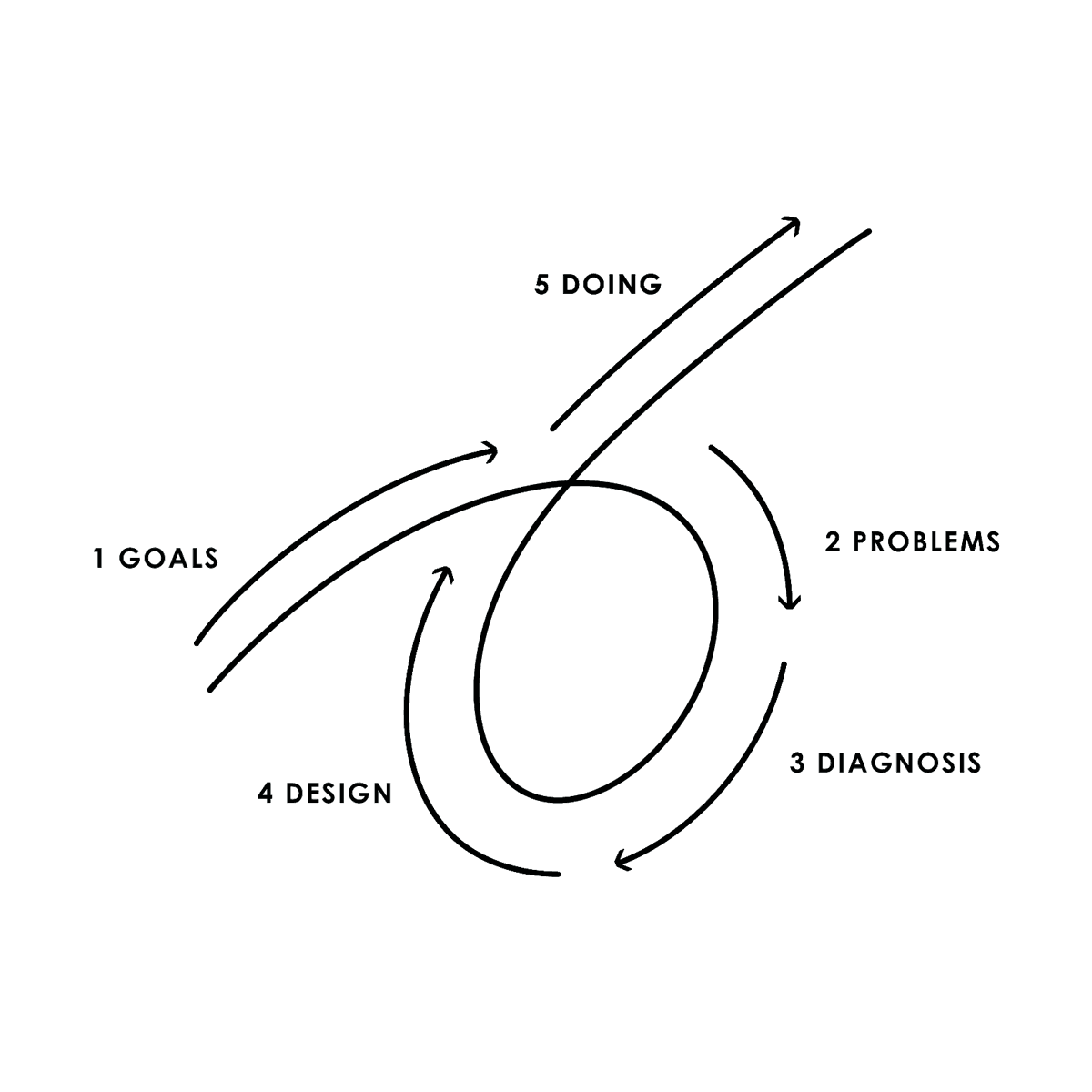
The practical application of this is a systematic process. You attempt a step. You fail. You analyze the outcome, identify the specific point of breakdown, and correct that variable. By consistently applying this diagnostic loop, you are always moving forward. Even if you were to fail at every single step initially, by correcting each one in turn, you would inevitably achieve mastery over the entire sequence. The system’s finite nature guarantees it.
Think of a simple layup in basketball. The fluid motion deconstructs into distinct steps: the approach and dribble, the protection of the ball during ascent, the jump, the release against the backboard, and the landing. A missed shot is not a random event; it is a failure in one or more of these specific components. Perhaps the approach was uncontrolled, the jump ill-timed, or the release angle incorrect. There are only so many variables. Mastery does not require magic; it requires the methodical refinement of a few key actions.

The Strategy for Inevitable Success
Your first task is to create a map. Most worthy goals have been achieved before. Your responsibility is to learn from the projects, mistakes, and insights of your predecessors. This research, whether through books, interviews, or direct observation, is the highest return investment you can make. It prevents you from working blindly and saves you countless hours of random, unguided effort. With this map, you adopt the Edison mindset. When a setback occurs, you must suppress frustration and activate curiosity. Pinpoint the exact component that failed. If it is a physical skill like the layup, record yourself and compare your form to that of an expert. If it is a business project, scrutinize your data to find where the metrics deviated from the plan. The more precise your diagnosis of the weak point, the more efficient your correction will be.
Here, we introduce a secret weapon in the pursuit of achievement: the principle of "good enough."
The temptation to achieve perfection in a single component of a system is a common strategic flaw.
Overinvesting in one step drains the resources needed for the others, compromising the integrity of the entire endeavor.
Would you rather execute a layup with a perfect ten out of ten jump but a shaky two out of ten release, or perform all five steps at a consistent six out of ten? The balanced approach is superior, because the ball goes in the basket. This logic applies to launching a company, learning an instrument, or building a relationship. With finite time and energy, balanced competence will always outperform one-sided brilliance.
An athlete who can only perform a spectacular dunk is a novelty. The teammate who is simply good at shooting, passing, and defense is often the more valuable player, because their composite skills create a greater strategic advantage. Aim for a standard of "good enough" that is truly effective.
When each part supports the others, the entire system performs with a near perfect sense of harmony. You will finish more races than the perfectionist who never leaves the starting block.
When these principles are combined, a new perspective on achievement emerges. Any goal is a finite list of steps. Every mistake is merely feedback that identifies a step in need of refinement.
When you use this feedback to adjust your next action, success ceases to be a function of luck and becomes a matter of logic. You are simply eliminating incorrect pathways one by one. If you remain in the process, a successful outcome is not just possible; it is almost certain.
To operationalize this, use a simple feedback cycle, a micro-loop for relentless progress.
1. Record: Document what you attempted and what happened. Be brief and objective.
2. Reflect: Identify the precise step in your process that failed.
3. Adjust: Formulate one small, specific correction for that single step.
4. Act: Execute the task again with the adjustment.
By cycling through these four stages, you allow the data to guide you toward a solution. You are not immune to failure, but by engaging in this process, you are no longer immune to success.