

Piece Nine: The Reflection System: The Art of Conscious Adaptation
[ 9 ]
In our previous explorations, we reframed failure not as an endpoint, but as the raw data for inevitable success. This final piece establishes the system that processes that data: strategic reflection. This is the master discipline that ensures all other components of your personal framework operate in concert, keeping your actions aligned with your vision over the long term.
Jeff Bezos, the founder of Amazon, articulated the core principle that governs this entire piece with profound simplicity: “Be stubborn on vision, and flexible on execution.” Your ultimate goal, that North Star you have defined, demands unwavering commitment. However, the path to that star, the daily tactics and specific methods you employ, must remain fluid. The moment a plan makes contact with reality, it begins to change. Circumstances evolve, you evolve, and every action provides new feedback, forcing adaptation. You hold the destination constant, but the route will, and must, evolve.
If Bezos had rigidly adhered to his initial method of selling books online, Amazon would be a historical footnote, not the global titan it is today. The vision was immense, but the execution was triumphant because it remained relentlessly responsive to reality.
The Twin Hazards of Execution
Before a strategy can be adjusted, however, it must be tested. Here lie two predictable hazards that derail ambition.
The first is a premature retreat. Consider the aspiring entrepreneur who launches a jewelry business, then pivots to art, then a finance blog, abandoning each venture the moment immediate success fails to materialize. The error is not a lack of talent but a lack of patience; the strategy is never given enough time to yield data, let alone results. This is akin to expecting physical transformation after a single day at the gym. Meaningful change is a product of sustained, consistent effort. You must continue moving through the tunnel, trusting that the light, while not yet visible, is there.
The opposite extreme is equally destructive: clinging to a failing method out of stubbornness or pride, even when evidence clearly indicates it is ineffective. This is not perseverance; it is a refusal to learn. Both paths, quitting too soon and persevering too long, pull you away from your vision. The solution is not to abandon the goal, but to refine the approach. Reflection is the compass that allows you to navigate between these hazards, keeping your execution agile while your vision remains fixed.
The Command Decision: To Pivot or Persevere?
Your reflections will inevitably lead to a critical command decision: is this specific approach still serving my vision, or is a pivot required? There is no magic formula, but a disciplined framework can guide this choice.
1. Pause with Purpose, Then Commit to Motion.
When resources like time and capital are scarce, strategic thinking is your most valuable investment. Sketch several potential plans, compare their merits, and commit to the most promising one. This cadence was mastered by Napoleon: meticulous in the planning tent, relentless and unstoppable on the field. Recognize that strategy without action is merely intellectual comfort. Once the plan is solid enough, launch with decisive force.
2. Give the Plan a Legitimate Test.
Remain with a tactic long enough to collect meaningful data. If you abandon it at the first sign of friction, you are training yourself to quit. Discomfort is often the first signal of impending growth. Lean into it and allow the process to teach you.
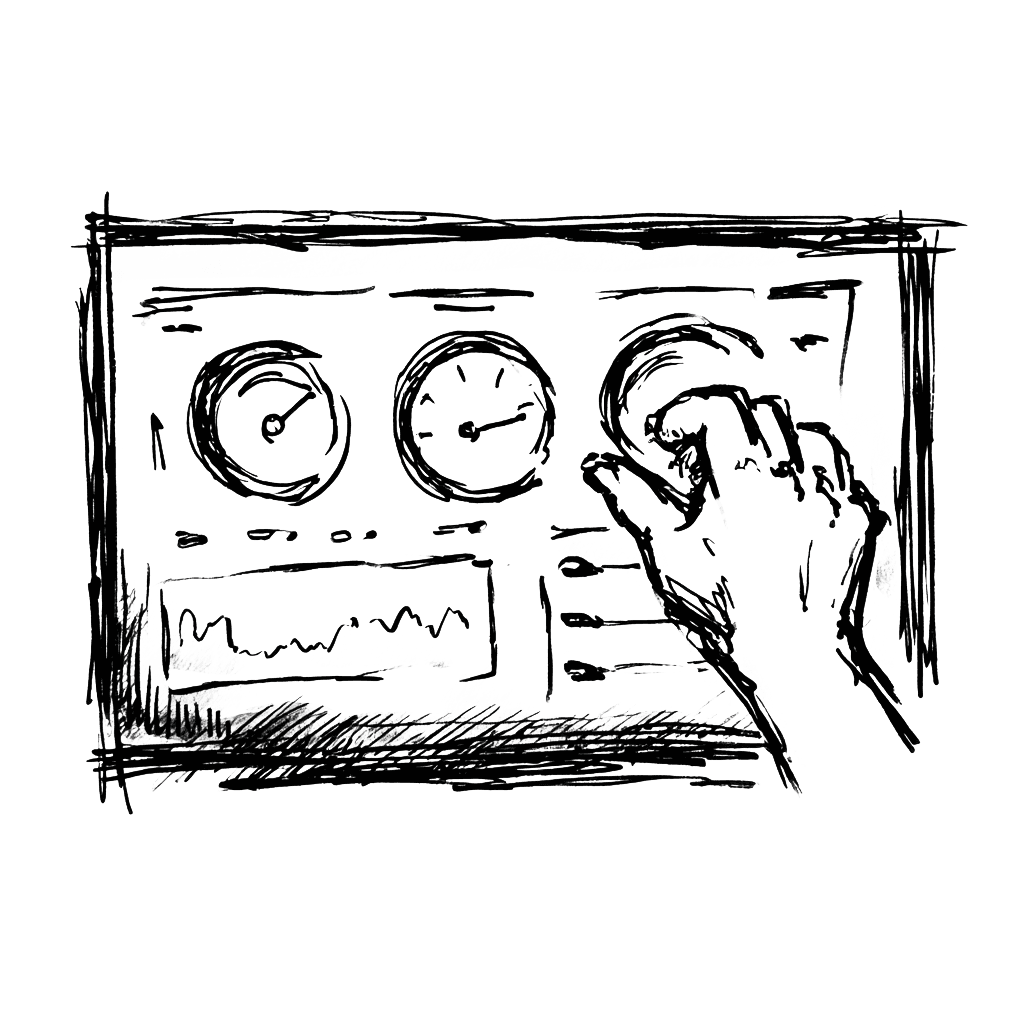
3. Read Your Data Like a Cockpit Instrument Panel.
A consistent reflection system transforms vague feelings into clear, actionable signals. These signals will tell you whether to pivot or to persevere.
You pivot when one or more of these conditions are met: (1) multiple cycles of tweaking your method have failed to move your core metrics; (2) new evidence invalidates a fundamental assumption, such as the market having no desire for your offer; (3) the approach is draining resources at an unsustainable rate that no adjustment can rectify.
You persevere when the opposite picture emerges: (1) small but consistent metrics confirm a modest upward trend; (2) the core concept remains sharp and valid, even if the technique requires refinement; (3) each round of effort is measurably improving the key skills that will guarantee long-term success.
This disciplined analysis is exemplified by James Dyson, who built over 5,000 prototypes before perfecting his revolutionary vacuum, and by the author who rewrites a manuscript countless times. In both cases, the vision was held sacred, but the execution was relentlessly refined based on feedback.

Weaving Reflection into Your Operating Rhythm
Knowledge of this framework is useless until it becomes an integral part of your life. The following methods will weave reflection into your routine.
Mandate Its Practice: Schedule a non-negotiable time for reflection. A five minute review at the end of each day, answering three questions (“What went well? What was a challenge? What is one adjustment for tomorrow?”), is remarkably powerful.
Use Event Triggers: Certain events should automatically prompt a deeper reflection: the completion of a project, the receipt of significant feedback, or the crossing of a major deadline.
Formalize Your Thoughts: The act of writing down your reflections, whether digitally or by hand, forces clarity and creates an invaluable record you can reference to track your evolution as a strategist.
This process of continuous, incremental improvement is what keeps your entire personal system running at peak performance. It strengthens your why, sharpens your identity, and fine-tunes your daily actions. Reflection is the master process that keeps your system alive.
Ultimately, building a reflection system is about cultivating the capacity for conscious adaptation. In a world defined by change, your ability to learn, adjust your course intelligently, and remain aligned with your deepest vision is your single greatest asset. This is the journey of purposeful achievement, where looking back with intention empowers you to move forward with ever greater clarity, wisdom, and impact.

You now have what most people spend years looking for.
The architecture of achievement. The real one, not hacks, not tricks, not motivation that fades by Thursday.
But you already know what happens next.
Understanding doesn't change behavior. Never has. Not once. Not for anyone.
The person who's read everything and built nothing, you've met them. Maybe you've been them. Seventeen saved articles. Four abandoned systems. A notes app full of insights that never touched an actual Wednesday morning.
That's not a discipline failure. That's a structure failure.
The distance between knowing and becoming isn't crossed with more information. It's crossed when the ideas disappear into your days—when you stop thinking about the system because you're living inside it.
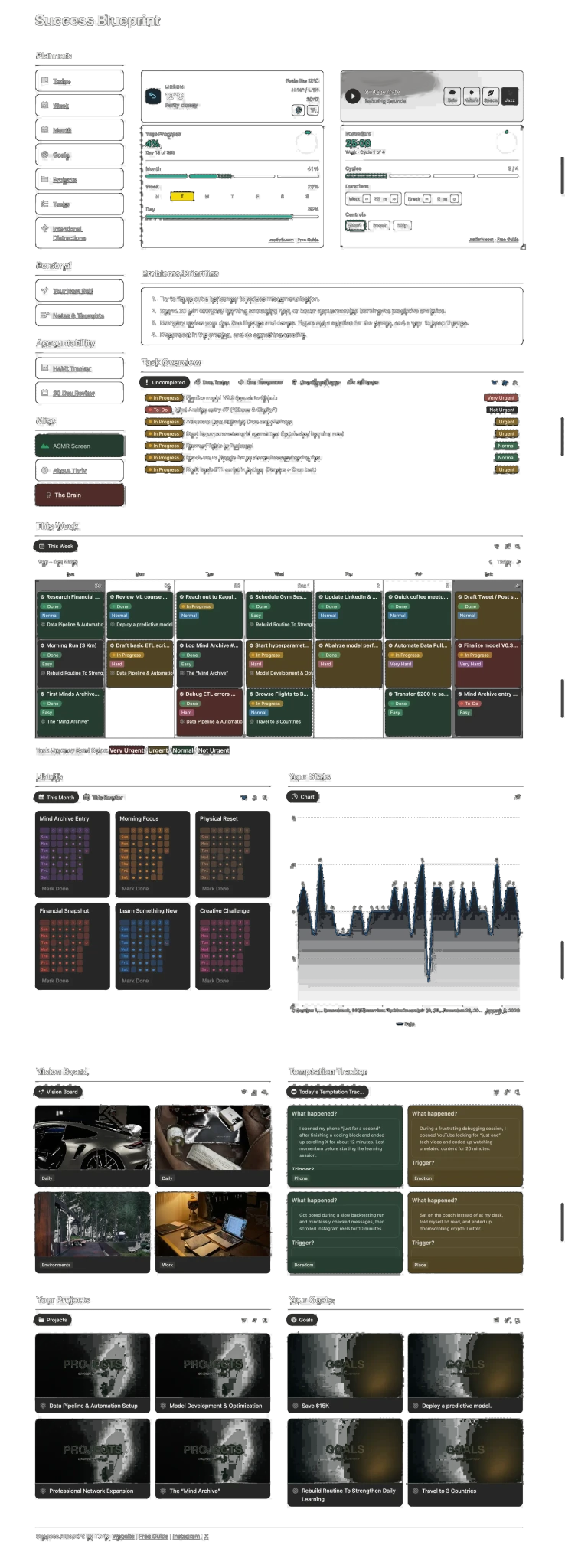
The Success Blueprint is the installation layer.
Everything you just learned, your why, identity-first action, flow states, the reflection loop, wired into a daily operating system.
Not a 47-dashboard monster you'll abandon in three weeks. Not a pretty notebook with blank pages and no structure. The middle ground that most systems miss entirely: lean enough that you'll actually use it, complete enough that it actually works.
Every element is there because it moves the needle. Nothing else made the cut.
You've read about the "leanest system for the biggest outcome." This is what it looks like when it's built.
Imagine six weeks from now.
The alarm goes off. No negotiation, no mental battle—your morning is already designed. You know what the first ninety minutes are for because you mapped it once and stopped thinking about it.
You don't wonder if you're working on the right thing. You don't waste weeks on tasks that turn out not to matter. The planning already happened. Now you just execute.
When you drift, and you will, the weekly review catches it before it costs you a month.
That's not motivation. That's machinery.
You already own $4 of this.
Code: YOUR399
Notion version: $20 → $16 Physical version: $40–50 → $36–46
You have the pieces.
Now build the puzzle.
Bonus Resources
Resource Name
Format
Link
cheat sheet - quick setup for entering flow
Access
worksheet to map your natural rhythms
Access
Checklist to run the Record-Reflect-Adjust-Act loop
Access
checklist decide whether to persist or change approach
Access